Showing posts with label TMA690. Show all posts

Saturday, October 5, 2013

TIPRR#5: Beginner's Guide to Community Based Arts


This text seemed to explore the optimum ability of the arts to be involved in redefining the story and identity of local cultures and to incite positive social change.  I sought to create a universal template for the process of involving the community in telling a new story, informed from the inside, about their shared experience, identity, and potential.  I was repeatedly reminded of the Interview with David Gauntlett[1] and its emphasis on the empowering aspect of the process of creating, as well as Peter Forbes’ essay[2] discussing the power of story to create social change.  Both of these seemed to inform my reading as I contemplated the potential for these programs to create lasting change and to actually redefine the personal identity of those who participate.

Largely the text seemed to argue that individuals and their communities need to resist the top-down identity and branding that tend to permeate societies via mass media.  It repeatedly expressed a distrust of the business-model of the press, and seemed to focus its entire energy on the business of telling the untold stories of ethnic minorities, and those socially marginalized for economic or criminal reasons.  I do feel that these stories need to be told, but I also felt that by choosing the entirety of the social issues addressed in this text to be at that end of the spectrum of social change, that the text perhaps alienated those of us who are also interested in telling or facilitating untold stories that might not seem quite so dire or politicized.  I feel that there is still great value in giving voice to the voiceless, even when the weightiest of social issues are not hanging in the balance. 

The format of the text centered around its acronym for the proscribed creative process: CRAFT for Contact (Forming connections with the people you hope to collaborate with), Research (Gathering information about the people and issues you will work with), Action (Producing a new work of art that “benefits the community”), Feedback (providing opportunities for reflection, dialogue, and social action), and Teaching (passing on skills to others to make the impact self-sustaining.)  Each of these points was explicitly illustrated in the 9 examples illustrated in the text.

I appreciated that the text acknowledged the existence and potency of digital communities.  It seems that a lot of groups that would share interest in such a project would be difficult to find in a concise geographic area.  Most of the projects presented could only work in a densely populated city where enough people of similar backgrounds or concerns could feasibly be gathered in one location. 

As I tried to identify a working model of this type of project that would resonate with me, I consistently encountered that online communities have a much trickier job of that first step – Contact.  Locating and creating relationships with the people you hope to involve is much trickier to do when your shared interest involves a negative (a need for change) rather than a positive.  On top of this complication is the existence of communities that do the exact opposite of what this text suggests and aggressively promote harmful or hateful communities.  The existence of support communities for those who wish to pursue extreme eating disorders, sites that teach youth how to be anorexic, rather than support them in rehabilitation, is a troubling example of this. 

Another issue that online community building faces is dealing with search-engine optimization.  This can be difficult, or expensive for a small organization and is pretty much requisite for finding like-minded individuals.  Cause-related Social networking is difficult, potentially expensive, or slow-going if word-of-mouth is the only means of growing the community. (Unless you stumble into an existing community.)

I tried to find an online community action tool for sharing or empowering stories for those affected by depression or mental illness, but the sites I was able to find were rather larger in scale than the projects described in Beginner’s Guide to Community Based Arts.  I found one that had a platform for sharing and discussing stories in an attempt to negate negative assumptions and stereotypes, but it was a small part of the larger website for the Anxiety and Depression Association of America. [3]   The scope of the entire site was so large and, frankly, corporate, that it ultimately did not feel to me like it met the criteria.  Several of the CRAFT steps were notably missing, (Research! Feedback! Teaching!) and I felt like it was more of a venting message board than an agent for actually changing paradigms.  I suspect that if I had time to dig deeper I could find a smaller, more effective platform somewhere, but the fact that it requires deeper digging is indicative of a potential problem.
photo

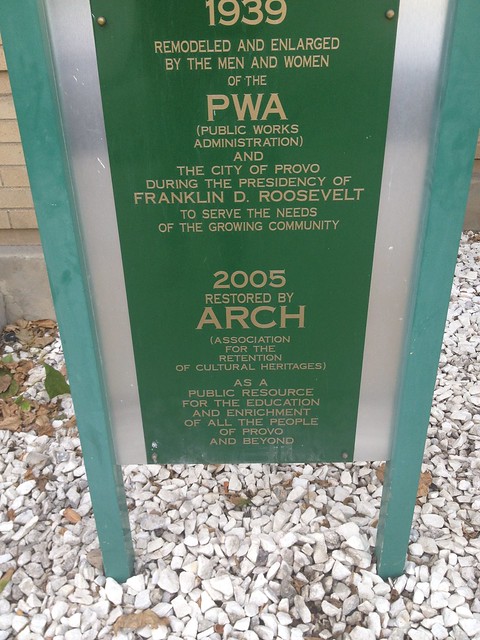
But, outside of trying to align this idea with my own digital experiences, I did see some potential for applying these ideas to real-life instances around me.  I was already aware of some concern over the preservation of historic buildings in Provo,[4] and I managed to walk by a well-preserved building just off of Center Street in Provo with a placard outside stating that it had been restored in 2005 by ARCH, the Association for the Retention of Cultural Heritage.  I attempted to find some information on this “Association” online and had no luck.  My search was overwhelmed by ARCH the (international) Alliance for the Restoration of Cultural Heritage – a fundraising site for saving historic sites threatened by war in the Middle East.  This sort of search-engine-optimization problem seems like a huge stumbling block for advancing these types of small, community-scale projects with online resources. I’m not certain that I have a solution for that problem, other than that many of them may need to spend some time carefully deliberating the naming of their projects and the choosing of domain names, and involve social media experts (in their Contact phase) to help them maximize search engine optimization at minimal cost.


[1] Henry Jenkins Interview with David Gauntlett, “Studying Creativity in the age of Web 2.0” http://henryjenkins.org/2011/08/studying_creativity_in_the_age.html#sthash.ipn5vuoZ.dpuff
[2] Forbes, P. The power of story.
http://www.wholecommunities.org/pdf/publications/Power%20of%20Story%202008.pdf
[3] http://www.adaa.org/living-with-anxiety/personal-stories/all-stories/7
[4] http://abouttownutah.org/2013/10/01/the-lds-church-wants-to-replace-provos-oldest-home-with-a-parking-lot/

Saturday, September 28, 2013

Theory Into Practice Reading Response #4 - Pop Culture in Literacy Pedagogy and Family Home Media

           Nothing that we've read thus far has evoked so much note-taking from me as Beach and O’Brien’s chapter on Teaching Popular Culture Texts[1].  It was so full of specific examples of application, and precisely defined proscriptions that there were a lot of concrete ideas that could be gleaned and immediately transferred into practice.  I felt this entire article interplayed interestingly with last week’s interview with Robert McKee[2] about the power of making and creativity.  Nearly every suggestion in this Pop-Culture-Text article focused on empowering students as creators of their own texts and as makers of meaning.  I appreciated the idea of bringing the process of learning how to read a text critically to the texts that students are already engaging in with earnestness and delight.  I do, however, see the potential for resistance.  For many people, and especially for vulnerable teens and adolescents, private media habits are intensely personal.  Reflecting upon them critically and publicly requires a willingness for vulnerability that I would anticipate most insecure teens to resist.  (Not unlike Drew’s reticence in About Home Movies.[3])
            I had read Dean Duncan’s article, Family Home Media[4] before.  It came up in context when I took a Children’s Media class from him, long before the rubber hit the road for application in my own family life.  Reading it again from my current perspective was interesting.  I still agree with the concepts in it, but for myself I have a much clearer idea of the work and resistance involved in putting those concepts into practice.  I don’t think the resistance was addressed in either article.
            My 7-year-old son, my oldest, has had a peculiar relationship with media from the beginning.  He has a tenuous, anxious relationship with videos and film, and he refused on pain of panic attack to watch anything with a plot until he was 4 and a half years old.  We still have to introduce new texts to him very carefully and often with bribes. He’s also revealed an unusual propensity for fixation, even for children at ages naturally prone to fixation.  This severely complicated my idealized vision of my own “family home media,” and I’ve never actually managed to steer it back to where I’d originally hoped it to be.  But I have learned to work with what I have.    I was interested to see how my willingness to work with my son and the media he was willing to engage with often paralleled the pop-culture-texts teaching described by Beach and O’Brien.
            Along with a host of other long-suffering parents, I have become well-versed in children’s media characters and constructed realities that my younger self would have scoffed at.  I have learned to engage with my son in creative play and discussion revolving around Jake and the Neverland Pirates and Lego Star Wars.   Certainly a part of me resists this because I perceive it as “low” art.  And certainly I’m still trying to compensate with more “high art” in areas he’s less resistant to, like bedtime reading.  But as much as I’d perhaps prefer his creative play to not revolve around licensed characters, that doesn’t mean that there is no creative value or potential for critical analysis in that play. 
            I felt that both Duncan and Beach/O’Brien addressed the need to help adults, parents, and children reflect upon their own relationship with media and how it could be refined and enriched.  They both encouraged adult/teacher figures to model critical thinking with casually encountered texts for the children in their care.  I think they even both encouraged blurring the distinction between the teacher and the learner in these conversations.  The biggest difference I felt between these two conversations was that the end goal of one was literacy skills while the end goal of the other seemed to reach further – to the becoming enlightened and improved by the sort of critical encounters with texts that literacy can facilitate.  Certainly Beach and O’Brien were less discriminatory about what texts are deserving of our deepest focus.
            My biggest question coming away from Beach and O’Brien’s article was whether allowing for more focus on pop-culture literacy will ultimately leave some students unacquainted with “high culture” texts that might have otherwise stretched them.  I can easily see the value in helping kids engage more thoughtfully with the texts they are already immersing themselves in.  But I think I’d personally resist doing that at the expense of exposing them to perhaps more meritorious material.  Or rather, while I’m willing to find ways to work with Lightning McQueen and the Wonderpets, I’m still looking forward to the possibility of sharing some delight in meaty polysemic cinema with my son.


[1] Beach R. and D. O’Brien. (2008). Teaching popular-culture texts in the classroom in Handbook of research on new literacies. Eds Coiro, J., M. Knoble, C Lankshear, and D. Leu. Lawrence Earlbaum. NY.
[2] http://henryjenkins.org/2011/08/studying_creativity_in_the_age.html#sthash.ipn5vuoZ.dpuff
[3] Best example, see: http://abouthomemovies.org/2012/10/30/love/
[4] http://magazine.byu.edu/?act=view&a=47

Friday, September 20, 2013

TIPRR#3 - Media Literacy, Story, and Creation

According to Cmdr. David G. Smith[1], the U.S. military has begun changing gears in training recruits. In accordance with advances in behavioral science, instead of promoting cohesion by dehumanizing individuals, they are teaching recruits about the history of their service. Thus far it is a measurably more effective means of increasing their camaraderie and ability to attach and commit to their unit.[2]
That story would be more powerful than force in creating real, measurable change in the values and commitments of a people should not be surprising.  As Peter Forbes[3] said, “You cannot demand a different world, you have to inspire it.”[4]
Indeed, it is increasingly apparent that what constitutes the culture of any group or civilization is the story that they share and the values inherent therein.  Harold Goddard said, “The destiny of the world is determined less by the battles that are lost and won than by the stories it loves and believes in.”[5]
Forbes seemed especially concerned about what happens when intentional and value based stories are replaced in our culture by “inauthentic” stories used in advertising.  He relayed a strong argument for valuing story more prominently as a culture, and using it to more virtuous ends.
Forbes quoted Ben Okri as saying, “Stories are the secret reservoir of our values.”  Okri has also said, “A people are as healthy and confident as the stories they tell themselves. Sick storytellers can make nations sick. Without stories we would go mad. Life would lose it’s moorings or orientation….Stories can conquer fear, you know. They can make the heart larger.”

There needs to be a cultural revolution in recognizing that story is an inextricable part of the human experience. That humans require stories to function is evidenced by the effectiveness of narrative-based advertising.  “You’re not selling product x, you’re selling a story.”  That we keep buying these stories (by buying the products that promise those stories to us), is evidence for the role of story in human development. Unfortunately, as Forbes expressed, the consumption of such stories leads to disconnection, rather than the connection that we need from our stories. In Crow and Weasel, Barry Lopez[6] says, “If stories come to you, care for them. And learn to give them away where they are needed. Sometimes a person needs a story more than food to stay alive. “

Forbes strongly promoted the use of story as an impetus for constructive social change.  He says that stories should be about relationships and communities, not about products or consumerist appetites. Leslie Marmon Silko[7] agrees, stating, “I will tell you something about stories …They aren’t just entertainment. Don’t be fooled. They are all we have, you see, All we have to fight off illness and death.” Forbes points out that in order to create positive social change, the culture has to be re-storied.  Legislative action is inadequate because “laws codify values – they don’t create them,” and the culture will not maintain a law that is not in-line with the collective story and values of its people.

The Co-Intelligence Institute has said, in The Story Paradigm[8], “Story can help us deal with causation, comparison, function, implications and context, as well. But it goes beyond understanding, description and control into the realm of mutual involvement, a realm where analytical reason becomes reductionist, inadequate to the task. The more nuanced, subjective, interactive and non-measurable a relationship is, the more story surpasses analysis in dealing with it.”  This is congruent with Forbes’ argument that story can be more potent than rhetoric.  “Stories help us imagine the future differently… a new story that helps people find their way out of the old story.”

Forbes indicated that authentic stories will define wealth as being about relationships, and not money.  Story itself is a powerful binder for catalyzing and maintaining healthy relationships.  In a 2013 New York Times article[9], Dr. Marshall Duke said that in studying children after 9/11, “[Those] who knew more about their families proved to be more resilient, meaning they could [better] moderate the effects of stress.”  He indicates that those who have a strong sense of the story of their family and community, beyond their own experience, had a stronger relationship with their families and a better resiliency toward life experience. Dr. Duke said that children who have the most self-confidence have what he … call[s] a strong “intergenerational self.” “They know they belong to something bigger than themselves.”

Stories frame the way we see ourselves, our relationships, and the world we interact with. Robert McKee has said, “Stories are the creative conversion of life itself into a more powerful, clearer, more meaningful experience. They are the currency of human contact.”

Stories are valuable both on an individual level and collectively.  The experience of encountering and processing or internalizing a story is definitive.  But so is the experience of crafting a story.  The digitally connected age in which we live has the potential to give voice to many more stories, but it also alters the author/audience paradigm.  If more people view themselves as contributors to an overarching community of story, the authority and exclusivity of authorship may be diminished, but the invested community grows.

In his interview with Henry Jenkins[10], David Gauntlett said that “Through making things, you feel more of a participant in the world, and you feel more a part of it, more embedded because you are contributing, not just consuming, so you’re more actively engaged with the world, and so, more connected.”  He emphasized that the value of creativity is not necessarily the output or product of creation, but the unquantifiable “happiness” associated with the process of creating. 

This certainly applies to authorship and story, as well as to any facet of participating in a creative act. This unquantifiable happiness is described by Deiter F. Uchtdorf[11]: “The desire to create is one of the deepest yearnings of the human soul.  No matter our talents, education, backgrounds, or abilities, we each have an inherent wish to create something that did not exist before
The process of participating in creation, even the broadly-defined “everyday creativity” described by Gauntlett, fulfills Joseph Campbell’s[12] experience of being alive: “People say that what we're all seeking is a meaning for life... I think that what we're really seeking is an experience of being alive, so that our life experiences on the purely physical plane will have resonance within our innermost being and reality, so that we can actually feel the rapture of being alive.” 

By broadening the definition of “creativity” to include anyone joyfully making something they have not made before, Gauntlett creates a paradigm that allows for the voice, experience, and perspective of any willing storyteller to be valuable, when constructed into a narrative creation.  This democratic definition invites the statement by Karen von Blixen-Finecke (pen name Isak Dinesen), “To be a person is to have a story to tell.”

There was concern, however, coming from Amy Ogata’s interview with Jenkins[13] that promoting the creativity of everyone, especially children, has in the past become a commercial construction that aims to “overlook difference while simultaneously selling exclusivity.”  She said it is “hard to escape the rhetoric of creativity used to sell items for kids.”  Indeed, when creativity itself becomes a story used by advertisers to promote consumer culture, then the value of the individual voice becomes a double-edged sword.

It may be helpful to revisit Forbes’ insistence that story, and possibly creativity, should be about relationships and communities, rather than commodities. There is certainly rich potential for enriching use of creative story-building here.  The creation of narrative can serve as an exploration of one’s own experiences and identity.  The process can accomplish finding the meaning and clarity that Robert McKee mentioned.

There has been much made of the psychological and physiological benefits of composing one’s own story, and giving voice to one’s own perspective, even if the result is never shared with a separate audience.  Dr. James Pennebaker[14] has explored this concept extensively and his research shows that the process of organizing one’s thoughts and experiences into a story has manifold benefits for the creator, regardless of whether their creation is ever shared.  Even those who immediately burned their narratives saw benefits.  The creative process of organizing and constructing a story is universally beneficial, as Gauntlett may have suspected.

[1] http://www.usna.edu/LEAD/Division%20Staff/David-Smith.php?iframe=true&width=770&height=620
[2] http://www.nytimes.com/2013/03/17/fashion/the-family-stories-that-bind-us-this-life.html?pagewanted=all&_r=1&
[3] http://www.wholecommunities.org/pdf/publications/Power%20of%20Story%202008.pdf
[4] http://www.wholecommunities.org/pdf/publications/Power%20of%20Story%202008.pdf
[6] http://www.barrylopez.com/
[7] http://history.hanover.edu/hhr/hhr93_2.html
[8] http://www.co-intelligence.org/PowerOfStoryLong.html
[10] http://henryjenkins.org/2011/08/studying_creativity_in_the_age.html#sthash.ipn5vuoZ.dpuff
[11] https://www.lds.org/general-conference/2008/10/happiness-your-heritage?lang=eng
[13] http://henryjenkins.org/2013/05/the-creative-child-meets-the-digital-native-an-interview-with-amy-ogata-part-one.html
[14] Opening Up: The Healing Power of Expressing Emotions by James Pennebaker, PhD